Jesus and Our Marbles

KOR_1297blog

Sunday. — I’m on my knees in a church pew, and — I’m waiting.

Sometimes church seems like the only appropriate place to go when my head feels like the inside of pinball machine. Voices are echoing and the organ is humming. And I’m not sure that anyone’s really listening, but, truth be told — I may not really be praying.

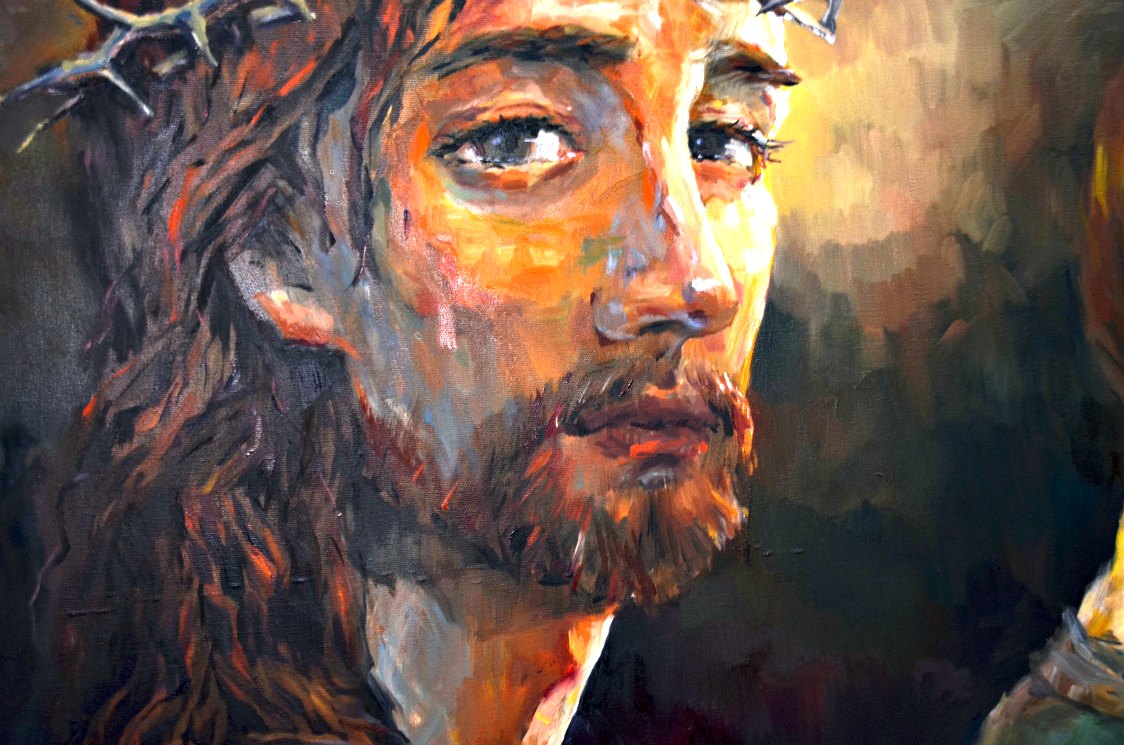
At St. Patrick’s, in Bay Ridge, the crucifix is painted on the wall. It’s a weird sorta mosaic. In most churches, it’s a statue or pillar — something three dimensional — just so you know that Christ is hanging right there in front of you. He’s solid. His limbs are smooth and round and the nails in his hands and feet are these tiny raised bumps that you can reach out and touch if you’re so inclined. But, not here. Not in this church.

I think about that — the dimensions of Christ — while I try to pray. I attempt to slow the thoughts that race around my brain. Today, there’s a lot going on. There are too many prayers. I can’t pick out just one. There isn’t enough time. I try to pray for everyone else and find some way to ignore all my crap. I mean, that’s what I should be doing. But then, where will I put it all? — All this stuff I brought here to iron out?

After the priest reads the gospel, our hearts spill all of their contents onto the floor like giant bags of marbles. Rolling wildly under the pews and across the aisle. No one else hears or sees them. — Well, maybe, mosaic Jesus does — but, if he does, he doesn’t move or change his expression. He’s still just casting his eyes down at Mary with that sad-face that all church Jesus’ have — I mean — he’s dying. And us, we’ve only lost our marbles.

At the end of the homily, my friend, who joined me for mass, grabs my knee. It was like everything that the priest said was tailored to us. With a sideways look, we silently acknowledge this. The strange thing is, we’d only walked down to St. Pat’s because Our Lady of Angels, twenty blocks away, had the wrong fucking mass times posted on the their website. So, when my buddy and I arrived at 11:30AM — missals blazing like spiritual gangsters — the priest was already sending parishioners off, in peace, to love and serve the Lord.

So, here we are, at St. Pat’s 12:30PM mass. Praying and not praying. Spilling our marbles. Waiting for JC to give us a sign that something good is headed our way. But, neither of us gets one. — JC is still motionless up there on the wall.

The mass ends, and after the priest and his posse file out, we follow suit. We leave our marbles scattered across the church floor. Because — it’s better that way. We know they’ll get sorted out here, even without us.

We walk down Third Avenue, where there’s a street fair in progress. There are bagpipers playing and little kids with painted faces and it smells like funnel cake and Italian sausages and my buddy keeps stopping in the middle of the street to adjust his shoe.

For some reason, around Eighty-Third Street, he and I both start to laugh. I’m not sure what came over us. I’m not sure what happened in that church. What we took. What we left behind. But, I will say this — even though I couldn’t say a prayer to save my life — I’m almost certain that one was answered.


Artwork Photo Credit: Jesus Christ, Painting in a Catholic Church in Maseok; http://d-roamingcat.blogspot.com/2013_02_01_archive.html?m=1
 

The Hunker Bunker

wyeth-day-dream-1980

There is nothing worse than being stuck.

I’ve heard it said, the definition of hell is standing in one place while wishing you were standing in another.

Unfortunately for us, it would appear that the human experience itself is an ongoing parade from one plane of our stuck-ness to the next. We stop. We assess. We look for new places to stand. And, me, I know — I’ve been in this spot before. I’ve felt it. — Change is imminent. I’m on the brink, but, I still find myself looking too far down the path ahead. I get caught up in distances that are too mysterious to gauge.

And, when I become overwhelmed by my own sense of place — or lack thereof — I do it. — I hunker.

My best friend can predict my hunkering — episodes of withdrawal and isolation — with laser-like precision. It’s no secret when I am tired of fighting the good fight. I become exhausted searching for the next, best place. So, I resign myself to my bed where I binge-watch television shows on Hulu and Netflix and tell myself that nothing will ever change. Ever. Ever. Ever.

It sounds terrible. But, in truth, it’s pretty fantastic. Not only is hunkering incredibly relaxing, non-invasive, and cheap — it’s the pre-cursor to breakthrough.

I wrote recently about the advantages of identifying patterns. — How labeling my predictable routines has helped me to see where I was wrong, or where I needed to change, or where I kept putting myself in harm’s way. And, yet another advantage of this self-awareness is — you know when things are about to shift.

Hunkering is a sign. And while I’ll admit that it’s a behavior that sends up some red flags, — mainly a house-ridden, quiet, and antisocial alcoholic — it’s not all bad, I assure you. I’ve camped out in the hunker bunker many times before. I know the drill. And, I know that what follows is the sincere desire, drive, and momentum — to evacuate.

An experienced hunker-er knows that change is inevitable. There are only so many hours we can stay in the good graces of our beds. There are only so many days we can devote to celebrating our own misery. And — there are only so many episodes of The Mindy Project available on Hulu Plus.

The truth is, if we stand in one place long enough, wishing we were standing somewhere else — we will eventually move toward that other place. We move because it is unbearable if we don’t. Sometimes, we don’t even know that we’ve taken the step.

To hunker is to catalyze.

So, I tell my best friend, lovingly — I’m going. Don’t call. Don’t write. Don’t text. I’m headed into the bunker. I know the drill. I celebrate my stuck-ness. I know where I’m disappearing to, and I know what’s coming. And, soon — I’ll emerge.

Because, after standing in the same place for far too long there is nothing else to do — but move.


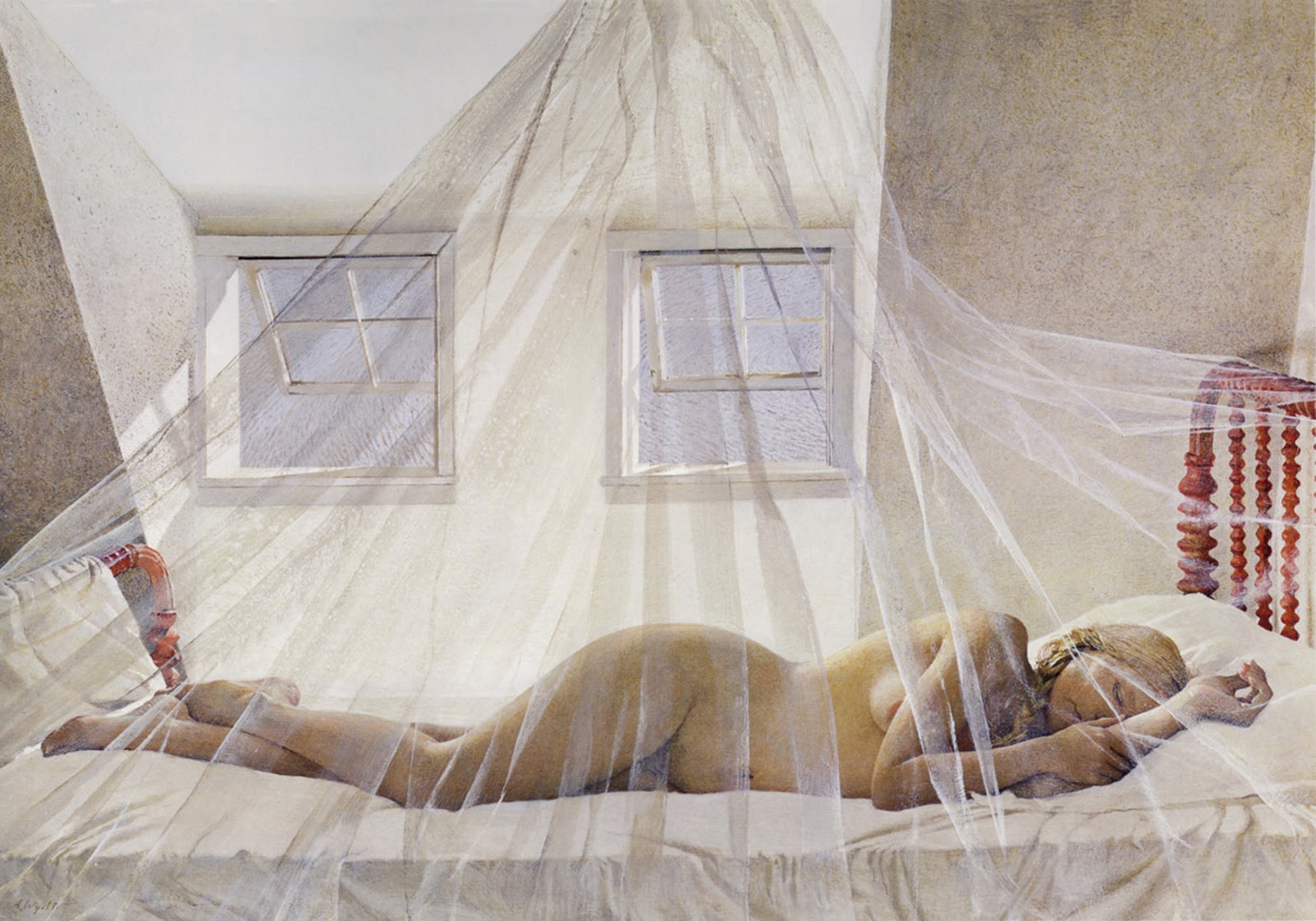
Artwork: Andrew Wyeth; Daydream, Tempera on panel.

Hand Signals

Shadow-puppets-with-hands

I’m laying in Shavasana on the living room floor.

My head is uncomfortably quiet. In the gold plated fixture on the ceiling where a lamp used to be, I see my own reflection. I’m wearing black, and, I stare at my corpse. Palms open. Hands signalling to myself — the crow above.

Since returning to New York, I’ve revisited many things. Most of which, are very different than the way I left them. People. Places. Feelings. While I was gone, I wasn’t the only one reinventing myself. Losing myself. Rebuilding myself. It was all happening here, without me.

The world spins madly on. But, this evening, after returning home from a 12-Step meeting, the only thing spinning inside me is an immense gratitude. — A gratitude so big that it quiets everything else.

In Portland, I’d all but lost my 12-Step program. I crumbled after meeting an unstable and dangerous person, and, it almost took me out of the game that made me. I forgot who I was and how I had arrived at my own sobriety. I connected confused feelings to 12-Step that were better left isolated, and, as a result, I returned to the angry and bitter woman I had worked so hard to leave behind. But, here, back home, I’m peeking through the crack in the door. I am revisiting the program that once saved me — with a childlike caution. There is comfort returning to this thing that never truly left me, though, I tried to tell myself it was gone. Things I once let frighten me, return and become my beacons. My reminders. — We are here. — And, none of us is safe, but, unified, we are all alive and trying.

Change, so incredibly painful, — ushers us forward.

In a church basement, things I had forgotten return to me. My ears, once again, are opened and humbled by someone else’s pain. And, in a strange moment where I feel loss and gain simultaneously, I remember how it feels to have a profound understanding of someone else without knowing them at all — the power just one voice can wield.

In quiet stillness, our hands reach out for each other. I am truly home again.

Nothing is the same. No one is the same.

Visibly shaken, our hands make quick work of signaling our stories. Dark shadows on a bright wall. And, in our shared state of despondent confusion, we are united in possibility.

And gratitude. — Immense and compelling gratitude. — The kind that quiets you for days. — Until you hear your own words leave another man’s mouth.

And, without making a sound, you have returned. To this beautiful, and changed, universe. — Brooklyn.


Three Years On The See-Saw

str180-1

We wake up. Really slowly.

Maybe it takes a year or two to move one, rotten inch. And, it’s sneaky, the business of waking up. Fucking subtle. So, don’t expect it to hit you hard or for it to happen all at once. It’s not some invincible force that saves and redeems you. But, it happens. There is an awakening.

Today marks three years sober. And, like every year, for the past three years, I’ve spent the week, leading up to today, trying to figure out where, exactly, I fit into all of this. Sobriety. — A word I throw around somewhat haphazardly. — I often forget the weight of things. Honestly, I’d being lying if I told you I felt one way or the other about it. In truth, it feels like I’m standing right in the middle of an enormous see-saw.

I wasn’t always up for the balancing act. Three years ago today, I wouldn’t have been able to stand in the middle of anything. Everything was an extreme. — Loss or gain. In or out. Good or evil. God or none. — One side or the other.

Today, I’m not so sure. I find that I’m often open to things that I’m not privy to. Miracles. Fate. Divine intervention. Maybe even some chaos and anarchy. — But, I’m open. That’s for sure.

The night before I got sober, I got cut off at my favorite pub. The owner told me, “Happy Birthday,” as I walked out of his bar, shitfaced. He knew all about sober anniversaries. He was a good guy who was happy to see me go. I, on the other hand, wasn’t so happy. I knew my drinking was bad news, but, I wasn’t so sure that the alternative was better. I think about her — Good ol’ shitfaced me. The girl who was so uncertain about the possibility of something genuinely good coming her way. And, three years later, I look back on that time, wide awake. I didn’t know how to comfort myself back then, because — I wasn’t there. But, now, I’m here every day. And all my voices speak.

The voice that reminds me to cry. The voice that tells me to step up. The voice that ushers me, with care, away from the people and places that no longer serve me. And, the voice that honors all that I’ve lost in these three years. — Together, we kneel at the graves of the many versions of myself that I’ve buried because they didn’t learn the right lessons.

I stand in the middle now, with confidence. Because I know, sooner or later, like it or not — this see-saw’s gonna flip and I’ll see what each end has to offer. I’ll stand high and I’ll sink low. Tides turn. And, I’m not afraid of the change anymore.

It’s nothing I can mark on paper. It’s not even a feeling. Three years is nothing but a notch I use to keep my place in the mess of cogs — a system in flux. Something that, next year, will be even more expansive. Awake and limitless, without warnings or boundaries. I count the years even though I know now — they mean nothing.

Just more room. Room for losses and gains. Ins and outs. Gods and none.

And me. There’s finally room for me.

And, I’m standing, three years deep — in the middle of it all.


Artwork: Life’s See-saw By: Brad Stroman; http://convergencegallery.com/stroman/stroman.html


Unedited Me

image

I keep asking myself — What am I really looking for in New York City?

I’ve never really sat down and thought about all the things I need in an analytical way. I usually just go with the flow, and, as things change — I make the necessary edits.

I was raised by two lawyers. So, I was editing myself before I even knew writing was a thing. And, when I did learn to write, because my folks had been coaching me, both consciously and unconsciously, to eliminate every unnecessary word, I never did beat around the bush. I always got right to the heart of the matter. Brevity. Was. King.

And, it’s true, frankness is all well and good — in expository writing. Brief writing. Law making. Compliance. Lawyer-y stuff. But, the trouble is — and always has been — I turned out to be more of a hippy-dippy spirit than my parents bargained for. I don’t mind if a sentence ends in a preposition. I won’t obsess about how my sentences begin — so long as I still have your attention when they end.

I see this pattern reflected everywhere. Especially in my sobriety. — I began the process of getting clean and sober, almost 3 years ago, in a completely analytical way. I made a checklist of all the things I could and could not do. I followed strict and specific rules. After all, brevity, I believed, would save me, so — I kept it short and sweet. And now, it’s all become second nature. As it happened, my own strict rules did not end up serving me in the way I had initially envisioned. So, I made edits. — My own, beautiful edits.

In the course of my life, I have edited everything. My love. My words. My body. My thoughts. I’ve tried so hard to squeeze all my things into a very precise framework. And, I truly believed, if I could just make everything fit, this plan of mine would produce some unblemished, polished, finished product. The perfect outcome.

On one of my epic walkabouts around Reed College campus, it hit me. — THE LESSON. — The thing that trumps all things I have learned here, and maybe, that I’ve learned in my entire life.

Scrap the edits.

It’s funny, because when I texted my father, the editor extraordinaire, in a panic about my big move, he texted me back with the great words of Julius Caesar before crossing the River Rubicon: Alea Iacta Est. — The Die Is Cast.

And, I see it now, when I look in the mirror. My face. My frame. My heart.

I see myself. Unedited. — And, my father was right. It is written. I am written.

I have put myself back together. All the things I have built — I have built from nothing. It took the better part of 6 years, but now, I am here. And, it’s too late for edits. — The trouble I could have saved myself. The heartache I could have been spared. The run-on sentences. The extra adverbs. The sentences that end in fucking prepositions. The EVERYTHING. — It’s all right here. She’s right herestaring back at me.

I tell my reflection: We won’t edit our love anymore. We get to own the heart we stitched back together. We won’t settle for less than we deserve. Our words, fair or foul — are ours. And, we speak for ourselves. We are our words — and sometimes — we’re dirty. Our body, it’s imperfect. We acknowledge our flaws. — Sometimes they’re all we have. We listen to our own quiet noise. You and I, we’re a team. The team.

*          *          *          *          *

Editing is for lawyers. And, I, I am a woo-woo-hippy-dippy-rule-breaker — with a semi-structured, somewhat-fool-proof plan. — An imperfect and beautiful representative of an unstable and curious humanity.

Alea Iacta Est. So, I scrap my practical edits and I ask myself again — What am I really looking for in New York City?

But, I think, the better question may be: What’s there, in New York City, looking for me? — The flawed, wounded, empowered and amazing — Unedited Me.


Dots

Photo Jul 21, 9 38 30 PM

When you go to school to become a writer, they don’t teach you to write. — They teach you to read.

The voices. The colors. The timbres. Each writer’s words ring out their peerless note — dissonance or harmony — no two stories are the same.

Every writer has her unique fingerprint — even in her plagiarisms.

In high school they instruct you — The beginning! The middle! The end! The kind of storytelling that has somehow been distilled down to a series of predictable climaxes — each is noted on a three foot by three foot chalkboard. Written carefully in smudgy, cursive letters. All of which — have no meaning.

If you learned to read properly, you already know this three-pronged formula is a useless chore. — A map that leads you nowhere and discovers nothing.

If you learned to read properly, you already know that each story is just one dot on an infinite timeline. And, in the futile hunt to uncover everything, the writer’s unrepeatable dot marks, without knowing it, the unexampled treasures that she alone has illuminated.

No beginning. No middle. No end. — Just moments. — Dots.

This weekend, I packed up the last six years. Books in boxes, old notes and bills, yellowed rolling papers, dried up pens, and renegade Christmas ornaments. So many dots. Too many dots. Wonderful and tragic dots.

One, I set aside. A single page, tucked carefully away, hidden neatly in between the pages of my copy of James Joyce’s A Portrait of the Artist as a Young Man. — an entry, torn from my journal. I unfold it, only days away from turning six years old, it reads:

July 30th, 2009

       It’s hot in Brooklyn. I’ve been sitting in front of the box fan, watching TV and wondering if I’ll miss the heat and humidity of New York when we get to Portland. — If we get to Portland.

      Sometimes I wonder if it’s possible for me to get anywhere at all, because I’ve been sitting on a couch, somewhere in this city, just waiting for something to happen to me.

     Three months until we leave this place. Home. Family. Friends. All for the wild frontier — The West. Ninety days to see what needs to be seen — To say goodbye. To worry. To plan. To Dream.

       But, I try not to worry. Because, on most days, I’d like to be anywhere but here.

I read it twice. Then three times. And then, for that girl, I weep. Six years ago — and I still remember how she thought this place could save her. How saying goodbye would hurt her. How her story, six years later, would read exactly the same way, but, — she — she is impossibly different.

Today, I cannot be mistaken for that girl. I know now that — it’s true — this place did save me. And, even in the sanctity of being saved, I will still choose to leave it behind — my savior. I return to a different place, revisit another dot. An old dot that, now, I can finally allow to be new. A story I know well, but, I’ve yet to write.

In my living room, I see it written on a piece of paper. — How I’ve learned to read here. I embrace the moments where Oregon has made me into something that New York City never could have — Beautiful. Seen. Heard. The words may read the same way, but, there is a new heart here. I read it — the story that was written for his heart — before I knew my own. Before I discovered my seperate pieces. My own, little dots — strewn wildly across the Oregon dirt. The seeds I once placed in someone else’s hands for planting. — But now it’s my harvest. — I’ve grown my own fruit.

In Oregon, I learn to read again. — To read myself. — I connect my dots. I learn to hold these new things — My love. My loss. My beauty. My strength. My pain. My sobriety. — like my children, to my breast. I shoulder their weight and carry them back to where I started. And I begin again.

I see them. They mark my own timeline. — My unrepeatable dots. — A goodbye. A worry. A plan. A Dream.

Each one on its own.

Each one, a place I call home.

Photo: Allison Webber; http://www.allisonwebber.photography/

(A very special thanks to the beautiful and talented Allison Webber for inviting me to be part of her photo series: The Personal Beauty Project. A series that empowers women, allowing them to be seen in the way that they see themselves. These images capture not only my spirit, but, the spirit of my Oregon. As I return to the East Coast, I am able to take these images with me. Images that, for me, represent so much of what and who I have become as a result of being part of this magical place. I encourage you all to enjoy Allison’s work at her aforementioned website.)

His Heroin(e)

Photo Jul 06, 6 56 57 PM

I lie on his bed while he shoots dope in the bathroom.

He runs the sink so I won’t hear him heat the spoon, but I still hear the flick-flick-flick of the lighter through the old vent in the floor. I can see though the walls. I. Hear. Every. Sound. The brown paste boils thin, to a liquid. The cotton top of a Q-tip soaks it up — breathes in the poison — like it’s alive. Each white fiber expands, taking on its color, like a web of molasses.

I stare at his water-stained ceiling. Rot from the upstairs apartment bleeding through the paint. The edges plume out and peel in the shape of mushrooms. I close my eyes. I see the tip of his needle drink it in. — His Heroin.

The plunger pulls back, and the spoon empties, like a tide going out. Smooth. Like a thick, dark caramel — drawn up by the moon. I cry quietly as I watch the way his cat just sits at the bathroom door. Waiting. — “C’mere kitty kitty.” I whisper.

I feel him poke his veins. Stick them. I found the syringes in his top drawer. Again. I hold the tops of my arms. I am outside my body. The girl is on the bed and the junkie is in the bathroom. I’m confused by my own acceptance. I allow this. My story. His story. Either way, it’s a war story. A story where sharp objects are made blunt and hard hearts are made harder. A world that defeats me with permission, not conquest. Then, I become her — some version of her — His Heroine. No. No. That’s wrong. It’s — His Heroin.

Some junkies will tell you that until you shoot dope, you don’t understand. — The high. The letting go. The relief. — It’s not true though. You don’t even have to move to understand. Just sit. Wait. — I sat perfectly still. I sat in another room while it swirled around me, not in me. A demon in the vents. You don’t have to feel that ugly, brown stuff pulse in your own, blue veins to witness its power.

Yield to it. Vulgar and dark. A power that turns your Hero into someone else. Something else. And then, you watch this creature lose everything. Lose themselves. Lose you.

But really………they just let you go.

Everything’s gone. And, all the while, I’m right there, it’s all right there. I try to trick myself into believing something that isn’t true. But, the cat’s still sitting, waiting, his tail curled neatly around his soft, white feet. And it is true.

He will give up anything. Anything. And, I learn, this includes me. It hits like a revelation. Christ Our Lord, where are you? I’ll never be sure. But, look, listen! The stained ceiling. The vent. The sink. The flick-flick-flick. The breathing cotton. The needle pulls.

I’ve dreamed it. No — no. I’m still awake. I’m still frozen. Me. The cat. We’re sitting in the same places.

I’ve seen it in the movies. I’ve read my Burroughs. It’s not the same. It’s not the same as watching him. Reading him. Feeling him slip. I cast him off like a thin line from the side of my boat, and he’s just a heavy lure sinking into the depths of this — some bottomless lake. His eyes disappear in a pool of water.

I imagine how he feels when he ties one off. How it makes him safer than I ever could. How the needle is the lover I never was and never can be. Sometimes, I imagine that he is a drunk, like me — not this. I imagine that the scars on his arms and legs are from something else — like the butts of his father’s cigarettes, maybe. It’s easier when I have someone to blame.

Fuck the poppy.

In the Springtime a coworker tells me — “It’s such a happy little flower!” I smile at her, but behind my face, under my skin, I grit my teeth. Poppies. At their dark, sticky center — lives the seed. Devil’s sap. I won’t eat your poppy seed bagels. Not anymore. And, now, I check the ingredients on the back of the multi-grain bread.

Heroin. Just a seed. It will always be stuck in my teeth. I will poke at my gums forever — but no amount of prodding will free it. It’s right there. On the tip of my tongue. At the base of my molar.

He is in the bathroom and I’m sitting on the bed. Waiting.
Later — with eyes half closed, he asks: “You didn’t see me, did you?”

“No.” I say.

But, while he sleeps, I do see it. How his love has left his body. And with gloves and bleach, I wash it away.

All that blood on the bathroom walls.


Photo: Allison Webber; http://www.allisonwebber.photography/

The Insignificant Thing

Photo Jun 16, 8 24 08 PM

The thing that breaks us, is never the thing that really broke us.

It sounds nonsensical. But — it’s the truth.

Our minds and bodies are magical things. — Beautiful and complicated mechanisms of celestial science and engineering, built to withstand incredible stress. INCREDIBLE stress. Though, I’ll say in earnest, for me, it doesn’t often feel that way. — Especially having been broken recently by an insignificant thing.

I’ve been here — a big-mouthed Brooklyn-girl — in Portland, Oregon. I’ve made my own way for quite some time. I’m not scared. I’m not in any trouble. I’m not facing imminent danger. At least, I’m not anymore. I’m just fine. Though, I hate the word. — Fine.

But, last night, after dropping my mother off at PDX, sending her homeward toward NYC, I swerved in my lane driving back home on I-205, sobbing hysterically. Minutes earlier, back at the terminal, when my mother’s arms broke their lock from around my sunburned shoulders, I felt it. — A sincere desire to be vulnerable again.

It only takes one insignificant thing.

In recent weeks it’s all flooded back. My time. Here. In Oregon. I’ve watched a lover and partner of almost 7 years walk out on me, never returning to say goodbye. I didn’t break. I’ve been arrested. Battled addictions. Marched myself through rehab like a soldier. I never broke. I watched my new lover and partner of almost 2 years get strung out on heroin — again and again and again. Not a crack. I stood, through all this, strong, like an Oregon pine. Dropping my dead needles. Picking up my pieces. Picking up their pieces. I pulled it all back together, my sap, like emotional super glue. — But, leaving my mother at the airport. — That’s what did me in.

The insignificant thing. The moment where you realize that you’ve held your own world together for far too long. Somehow, even after standing in the eye of the storm, it’s in the push and pull of the insignificant things where we find we’re — Tired. Broken. Lost. And still, we find it difficult to let go. The body, in all it’s magical resilience, resists giving way. Finally straining and, eventually, snapping under the weight of this thing that reminds us — We must respect the nature of things.

A friend of mine, who got divorced a few years ago, bravely escaping an abusive relationship, recently told me that she’s tired of being the “strong one.” I know what she means. We send each other notes. We tell each other that we’re better for it. But, in truth, we’d both take happiness over fortitude any day.

Blinking back more tears, I struggle to see this place. — Oregon. — These trees. The Gorge. The Wild West. Open air and unspoiled land. This place, by nature, has made me an adventurer.

It’s not insignificant that, here, I have learned how to be shipwrecked and to wash ashore — wet — but still breathing. What’s more, I’ve learned that I can fall in love again. I can heal myself. And, I can skillfully duct tape my 2001 Honda Civic back together — with expert craftsmanship — and not care what my father has to say about it.

But, the insignificant thing I can’t ignore is this — an unshakeable feeling that, it’s possible, I don’t belong here.

There are only so many storms I want to weather. Only so many loves I will stand to lose. Only so many places where I’m no longer haunted by the person I once was.

A long time ago, in a one-bedroom, railroad apartment in Greenpoint, Brooklyn, I held a love bigger than my heart was meant to carry, and I told myself — Dream big. I freed myself up and, for a time, I loved fearlessly.

Those things I told myself back then — they weren’t insignificant. They were my system of road maps. Maps for letting go. Holding on. Surviving. Breaking. Rebuilding. Reviving. Re-starting.

On I-205, a man in a Toyota Tundra watches me sob at the merge. I allow it. I allow my mother’s departure to break me. Suddenly — I care not for strength. I give up on mourning the things I lost. I decide to abandon the dream I was hell bent on living so long ago. I allow myself  to want again.

Something else. Someone else. Somewhere else.

And, before I reach the exit for Powell Blvd., I watch the course of my life change in my side-view-mirror — the one that’s duct taped, securely, to the driver’s side door.

And, without anyone else’s permission, I vow to follow it closely — wherever it goes — my insignificant thing.


A Mass In The Trees

Photo Jun 02, 9 31 35 PM

In bed, my eyes open and look upward. The world is white and dry like the paint that coats the ceiling. I turn my whole head to look at the bedside clock instead of moving each eyeball in its socket. 6:48AM. The world is still lighting up and the overcast hue of a Portland morning bleeds out from behind the red bed sheet that has served as my curtain for almost a year. I lay there, unmoving, until 7:02AM, when something shifts. My foot, or my thigh, I can’t remember. My own body, now separate from my head, pulled its legs from between the sheets. Stepped into dirty jeans, piled on the floor beside the bed. The pants rose up around my ankles without obvious help from my hands.

I stare into my mirrored face in the bathroom. Flecks of make-up and dust surround my reflected portrait. I look tired. Old. Worried. I think I need saving. I need a blessing. I need someone to hold their hand out over me and make me well. A brush to paint over the dark circles of my eyes and make me appear fresh and young. I need a priest.

As a child there was a magic in the church. The clergy. I still remember the robe, a long green smock with gold threads, that Father Kraus used to wear as he billowed back and forth across the altar of St. Charles Borromeo in Brooklyn Heights. My mother singing out in the folk choir as I sat in the front right pew, on my knees, waiting. Not for salvation or peace, but to be heard. The smell of something ancient and holy. The hollow cold of the marble and stone. Each face, frozen, in its station of the cross. Back then, I believed in something. I’m not sure it was Jesus, but that church, in it’s ethereal enormity, made me feel as if I were part of something larger than my body, two arms, two legs, and a head. I prayed. I knelt at the statue of Holy Mary, her eyes cast to the floor, just to the left of the lamb that bowed at her feet. Mother of God.

Father Kraus is dead and I am in Oregon. I walk out of my apartment and drive to morning mass at St. Ignatius on Powell Boulevard, which in stature, has only a fraction of St. Charles’ dignity. I haven’t been in a Catholic church in years. The light is yellow and everything is as gold as idols. Old biddies in beige shoes and nuns in habits chant the rosary and I don’t belong here. I could not belong here. I entered my pew and sat, eyes closed, and let the sound wash over me. A bell chimes. Enter the priest. His robes are purple and stiff, unlike Father Kraus’, who upon his entrances appeared a holy wizard. I allow the routine of the service return. The call and answers, the prayers, the kneeling, then standing, then kneeling, then standing, then kneeling, then standing again. I swallowed my communion, but, it didn’t taste the same. I genuflected leaving the pew and my knee hit the floor with force before reverence, there will be a bruise.

On the steps of St. Ignatius, I felt as empty upon my exit as I did when entering the heavy door into the stale, sour air. Outside again, new breath moved in my lungs and Oregon sky pulled me closer. There are mountains nearby.

At the trail head, leaves crunch under my feet. The trees arch around me like long arms, bending so slightly, to hold me to the path. A chilled gust of air moves their last leaves, ushering me forward. I walk in quiet, the sun burns off clouds and beams of light search for the ground through the canopy. Pine needles dance in circles as they fall to their soft beds, made of their fallen comrades. Fall color cascades. The earthen smell of damp moss reminds me of the wet cold smell of St. Charles. The landscape opens up as I near the clearing and the wind echos like my mother’s footsteps on the marble.

I walked for miles. And became a part of this church. Stopping at its stations to sit on stumps and draw air into nostrils, flaring and alive. At the top of Powell Butte, the sky is open. Mt. Hood is raised in the east like a statue. The sun cradles its peak like a halo, and a soft ring of clouds hangs at the crest, shrouding it in white and blue, like Holy Mary. A beam of sun cast to the Earth, just to the left of the lamb that bowed at her feet. Mother of God.


(A Mass In The Trees is an excerpt from my essay collection: The Ascent, And Other Essays.)


Bitter(s).

AngosturaBittersAd

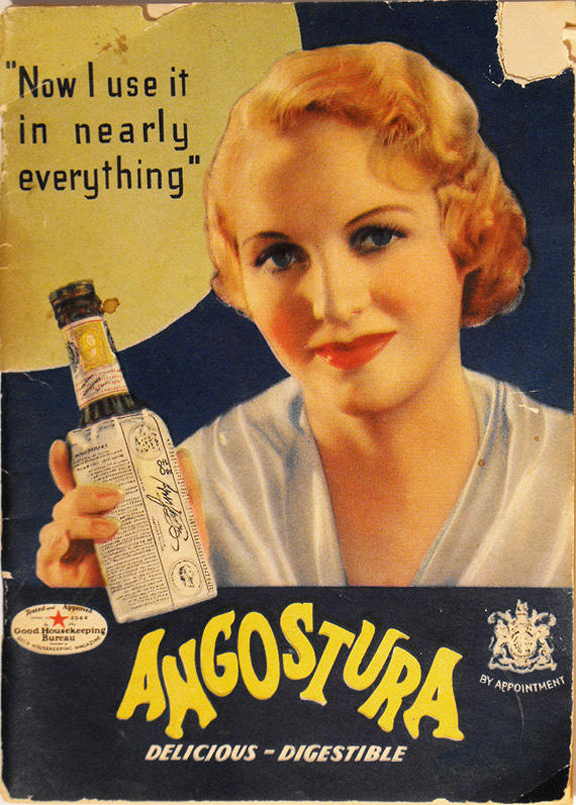
I sit at a bar shaped like a horseshoe and I order soda with Angostura bitters.

My 12-Step friends will hold the bitters against me — the same way they do when I lick the side of the vanilla extract bottle while I’m baking. I decide I don’t care.

I’ve been waiting for this.

I sit across from a hipster-geek in a wool, skull cap. The weather’s too warm for that, but, in Portland, no one cares. The bartender showcases a tequila bottle I don’t recognize for two drunk women at the end of the bar. They snack on fried food and chew with their mouths open and they don’t realize how old they look, bat-bat-batting their eyelashes and laugh-laugh-laughing at something the bartender says, but, everyone knows without hearing — it isn’t funny. Their husbands are outside smirking and smoking cigarettes. They turn to gawk at a group of three, tall twenty-somethings who walk by in patterned leggings that hug their perky, little asses.

I hammer my straw down into the ice, like I’m breaking something up. I stir — like there’s whiskey at the bottom of my glass. There isn’t. But, I continue eyeballing the good shit on the shelf.

I pass this bar every day. I look in its big, rectangular windows. Behind my own reflection, I see smiling lips that leave blots of red lipstick on the edges of tumblers and the tips of little, black straws. I wanted this — to sit here. To feel it. Soft leather. My purse dangling from a hook at my knees. I wanted to breathe out. — A release. A homecoming. My heels drawn up against the sides of a bar stool. — I’ve waited.

The perfect conditions. The right amount of cloud cover. The slice of evening right before the Saturday crowds filter in through the angled, double doors. A hum, a quiet energy — like something might happen. But it doesn’t.

I can’t explain it. — It’s not what I wanted.

The hipster-geek doesn’t look up from his smart phone, even when his hand searches along the bar for his drink, which, I am certain, is an old fashioned. The older women, who think they’re young, wave their hands back and forth. Pinot gris sloshing at the sides of their glasses, just barely contained. The bartender reaches for his bar rag, but, in the end — doesn’t need it.

I ask for my bill.

“All you had was soda. Right? We don’t charge for soda.” The bartender walks away from me. So, I thank his back. This is what being castrated feels like — I imagine. Suddenly, I’m worth even less than the dollar it cost for me to keep the seat warm.

Whatever it was I was hoping I’d feel — I know now — I can’t anymore.

The chewing, cackling hags. The lechers with cigarettes that dangle from their lips. The bartender’s display of insincerity and faded tattoos. The smell of spilled beer and dirty mop water. It’s hardly a return to the days I used to live for. — His hand grabbing for mine, while we poured over menus, the sun sinking into another river. Here, I’m lonely. And, the wood of this bar is scratched.

At home, I crawl into bed and I lay very still. I bury a feeling I didn’t know I still had.

I just wanted a moment in the bar. But, the moment’s gone.

Rain taps the window and the cat swats the venetian blind and I miss things I haven’t missed in a long time. Adam. And New York. And our railroad apartment. And they way the sun spilled over Nassau Avenue in the summer when I was twenty-five.